The useful version.
A little context. A clear takeaway. Short explainers for people who want to understand the work behind AI.
AI has a physical footprint.
Checked Nov 23, 2026 · Draft for Kevin’s review- 01
AI relies on electrical and thermal infrastructure, not only model capability.
- 02
Efficiency, useful computing and lifecycle impact are different measures.
- 03
A company-reported ratio needs its period and boundary attached.
Read the source:Microsoft Datacenters · Measuring energy and water efficiency - 04
Map the dependencies and name the questions before judging the headline.
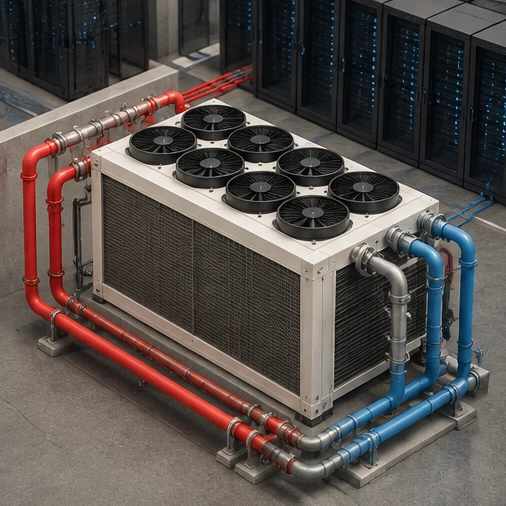
Closed-loop does not mean zero-water.
Checked Nov 23, 2026 · Draft for Kevin’s review- 01
A closed technology loop does not describe the whole heat-rejection path.
- 02
Recirculation can coexist with evaporative heat rejection elsewhere.
- 03
Water consumption, withdrawal and upstream water have different boundaries.
- 04
Ask which loop, which weather assumptions and which reporting boundary.
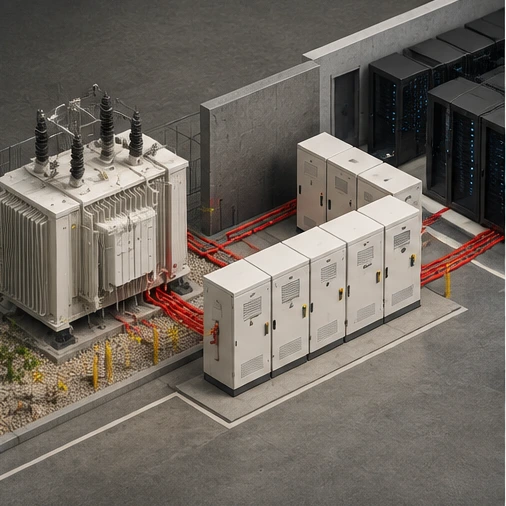
Follow the power, not just the rack.
Checked Nov 23, 2026 · Draft for Kevin’s review- 01
Utility, conversion, protection, stored energy and distribution form a dependency chain.
- 02
The architecture and acronym meanings vary; a generic map is not a one-line drawing.
- 03
Two drawn paths do not establish independent service or readiness.
Read the source:ASHRAE · Commissioning and Performance Validation - 04
Use public diagrams for literacy; only authorized people and procedures govern real work.
Read the source:ASHRAE · Operations and Maintenance

A useful AI workflow starts smaller.
Checked Nov 23, 2026 · Draft for Kevin’s review- 01
Choose one recurring task with bounded input and a stable source of truth.
- 02
Specify a goal, context, source and expected output.
- 03
Check claims against the source; workspace access and privacy settings vary.
- 04
Generated operational content is never an approved procedure or control action.
Read the source:ASHRAE · Operations and Maintenance - 05
Stop if permission, reliable evidence or accountable human approval is missing.
Before you clone, read the boundaries.
Checked Nov 23, 2026 · Draft for Kevin’s review- 01
Classify the repo: official example, research artifact, simulation or operational software.
- 02
A last-push timestamp is not a verified meaningful update or readiness score.
- 03
Inspect license files, dependencies, issues, releases and known advisories.
- 04
Read in the browser first; isolate any approved experiment with synthetic data.
Read the source:GitHub Docs · Navigating code on GitHub - 05
Public/open-source does not mean safe, supported or production-ready.
What “AI infrastructure” actually means.
Nov 10, 2026 · 2 min read · Example draftWhat happened?
AI conversations often focus on model capability. This example shifts attention to the physical systems and operational work that support it.
Why does it matter?
A capable model is not, by itself, a reliable service. Infrastructure, governance, and people need to work together.
What should you take away?
Map the dependencies, name the owners, and define what ready means before treating a system as ready for service.

Readiness, in three questions.
Nov 3, 2026 · 2 min read · Example draftWhat happened?
This example examines the gap between completing technical work and accepting operational responsibility for it.
Why does it matter?
A completed milestone can hide unanswered questions about ownership and change. Shared understanding makes a handoff more meaningful.
What should you take away?
Ask what is ready, who owns the next decision, and how a change will be handled. Use the answers to surface uncertainty, not just to complete a checklist.