A useful AI workflow starts smaller.
Choose one recurring task, a source of truth and a checkable output. Keep the approval with a person.
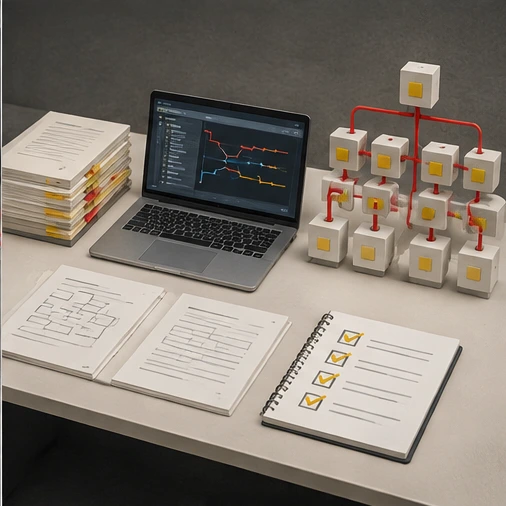
Public-source synthesis adapted from the Field Guide. Example editorial and spoken copy for Kevin’s review; not supplied personal opinions, firsthand experience, or published work.
Start with the task, not the product.
An ordinary, bounded task is a better test than a promise to transform an entire function. Examples include turning public notes into a draft agenda, creating flashcards from a fixed source or comparing a small set of published documents. Define the input and output before choosing Copilot, Claude or ChatGPT. Microsoft’s prompting guidance proposes a goal, context, source and expectations—useful structure for making the request explicit.
A tool’s ability to hold files or project context does not make those files correct, complete or approved for upload. Anthropic and OpenAI document project features with account and workspace caveats. Start from a stable source of truth, use public or synthetic material in these examples, and keep source references attached to the draft output.
Define a result you can check.
A measurable output might be a five-row action table with evidence for every row and no invented owner or date. Test whether a human can trace each statement back to the approved input. Include a missing-owner case, a contradictory date and an out-of-scope request. Asking a second model to agree is not independent verification; the underlying source still matters.
Account differences matter too. Connected work data, research tools, collaboration and usage limits depend on licenses, administrator settings and rollout. Product documentation describes capabilities; it does not grant permission to use employer or customer information. Consumer and business data policies should not be treated as interchangeable.
The stop condition belongs in the workflow.
If a wrong answer could become an equipment action, life-safety decision, engineering approval or uncontrolled disclosure, do not use a generative draft as the authority. Generated operational content is never an approved procedure or a control action. Missing access permission, an unstable source or no accountable human reviewer are reasons to stop and redesign the task.
For a low-risk trial, compare the reviewed output with a manually completed example and log both corrections and useful time saved. Do not invent a productivity percentage. The learning question is whether this specific task becomes clearer and more reliable under human review—not whether the tool can produce fluent text.
Sources and further reading
Get started writing prompts in Microsoft Copilot
Public page checked; goal, context, source and expectations framework. Account-specific source access varies.
What are projects?
Public page checked; project experience and collaboration vary by account and rollout. No beta automation is used by these recipes.
Projects in ChatGPT
Reviewed public source
Deep research in ChatGPT
Reviewed public source
Managing data sharing and privacy in ChatGPT Business
Reviewed public source
Is my data used for model training?
Public page checked; commercial-policy scope only. Consumer accounts have separate terms; approval to upload data is still required.
Operations and Maintenance
Reviewed public source
The systems matter.
So does the conversation.
Grounded conversations about AI infrastructure, critical operations and leadership.