USEFUL AI. ACCOUNTABLE PEOPLE.
A small task. A clear source. An output you can check. Practical learning and drafting recipes—not operating authority.
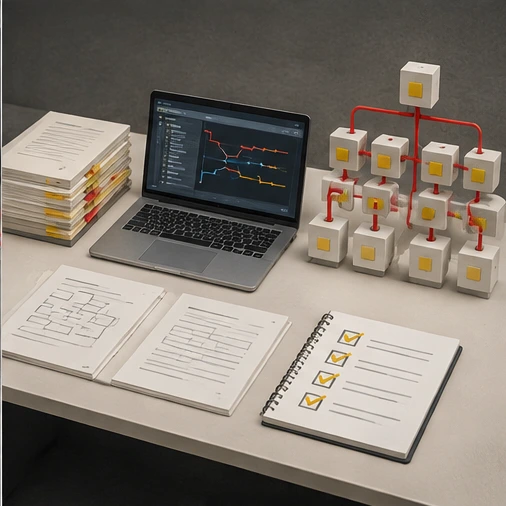
IS THIS A USEFUL AI WORKFLOW?
Define these boundaries before trying AI: Recurring task, Stable source of truth, Bounded input, Measurable output, Risk if wrong, Human approval, Access / privacy.
Checklist only. No task data is collected, stored or sent to an AI service. Generated operational content is never an approved procedure or control action.
CHOOSE A TASK THAT FITS.
6 draft recipes
Notes into a checkable action draft
Prepare a follow-up for a community planning meeting without inventing commitments.
Expected output A draft table whose actions are traceable to evidence, plus an explicit list of missing owners or dates.
A public document, a clearer brief
Turn one published learning document into a decision-focused reading brief.
Expected output A short draft with evidence quotes, separate interpretation and a missing-information list.
Source-grounded study cards
Practice infrastructure vocabulary without turning a model answer into operating instructions.
Expected output Six draft cards with short evidence quotes and explicit scope limits.
Make an explanation easier to follow
Review a public-facing technical draft for clarity while preserving uncertainty.
Expected output An editorial change table—not an automatically accepted rewrite.
Compare claims, not headlines
Compare two or three public sources on the same topic with traceable boundaries.
Expected output A source-comparison draft that separates facts, reporting boundaries and unanswered questions.
One source set, several review drafts
Adapt an approved public-source outline into formats without inventing the creator’s voice or footage.
Expected output Five separately reviewable drafts with shared provenance and no claim that any video or post exists.
SMALL MOVES. CLEAR BOUNDARIES.
Verified GitHub keys, documented product features and reusable editorial prompt patterns. No guessed tool shortcuts.
Find the keys for this GitHub page
On GitHub.com, ? opens the page-specific shortcut dialog. In source-code browsing, t activates the file finder and y expands a file URL to its canonical form.
? → page shortcuts / t → file finder / y → canonical file URL
Check: Use the dialog on the page you are visiting and check the URL before citing a file. These are GitHub keys, not this site’s shortcuts.
- Platform / version
- GitHub.com web / source-code browsing on desktop
- Plan / scope caveat
- Character shortcuts can be disabled in accessibility settings. Keys do not apply while typing into an input; page context matters. Repository access permissions still apply.
- Last checked
- Nov 23, 2026 · Draft
Give the prompt four anchors
Microsoft’s official prompt guidance uses goal, context, source and expectations. A clear source boundary helps a reviewer spot unsupported output.
Goal: [task]. Context: [audience]. Source: only [permitted input]. Expectations: [format / evidence / unknowns].
Check: Check every returned claim against the source; the framework does not guarantee correctness.
- Platform / version
- Copilot experiences / manual prompt pattern
- Plan / scope caveat
- Work-source access and attachment support vary by account, plan and settings. No special keyboard shortcut is claimed.
- Last checked
- Nov 23, 2026 · Draft
Keep a learning topic together
Where available, use a project to group permitted learning context. Keep a short source list and instructions that forbid operating steps and invented evidence. Ordinary chat is the fallback.
Topic: [public learning question]. Sources: [fixed list]. Boundary: learning only. Output: draft with evidence and unknowns.
Check: Verify output against the source and check project visibility before adding material.
- Platform / version
- Claude web / project experience depends on rollout
- Plan / scope caveat
- Free project limits, paid collaboration and staged beta behavior vary. Do not assume autonomous project threads or organization-wide sharing.
- Last checked
- Nov 23, 2026 · Draft
Bound the research before it begins
For optional deep research, specify a fixed question and allowed public sites; review the proposed scope and verify the final citations. A manual excerpt comparison is the fallback.
Question: [one question]. Allowed sources: [primary sites]. Return claim / quote / URL / date / boundary / uncertainty. Mark inaccessible sources.
Check: Open the originals. Do not treat a generated citation or plausible date as verified evidence.
- Platform / version
- ChatGPT web / optional deep research
- Plan / scope caveat
- Plan, territory, workspace and usage limits apply; connectors may need separate permission. No paid access is presumed.
- Last checked
- Nov 23, 2026 · Draft
Read before running
Use browser code navigation to follow definitions where supported. Read README, license, dependency files, network calls and security guidance before considering an isolated experiment.
Problem → category → license → dependencies → permissions → commits/releases → advisories → review owner
Check: Check current repository evidence and public advisories. Absence of an advisory is not proof of safety.
- Platform / version
- GitHub.com web / supported languages and indexed repositories
- Plan / scope caveat
- Read-only review needs no runtime or API key. Any execution requires its own qualified security, data and licensing review.
- Last checked
- Nov 23, 2026 · Draft
Ask for evidence or an unknown
An editorial prompt pattern, not a product command: make unsupported information visible rather than asking the tool to fill every blank.
Use only this source. For each claim, quote the evidence. If evidence is missing, write ‘unknown’. Separate fact, interpretation and question.
Check: Spot-check all quotes and deliberately include one missing fact in the trial.
- Platform / version
- Any approved text chat / manual prompt pattern
- Plan / scope caveat
- Results remain drafts; the instruction cannot guarantee compliance or grant data permission. No shortcut key is claimed.
- Last checked
- Nov 23, 2026 · Draft
The systems matter.
So does the conversation.
Grounded conversations about AI infrastructure, critical operations and leadership.