Follow the power, not just the rack.
A utility-to-rack map connects the vocabulary to the dependency chain. It is a way to learn—not an electrical work instruction.
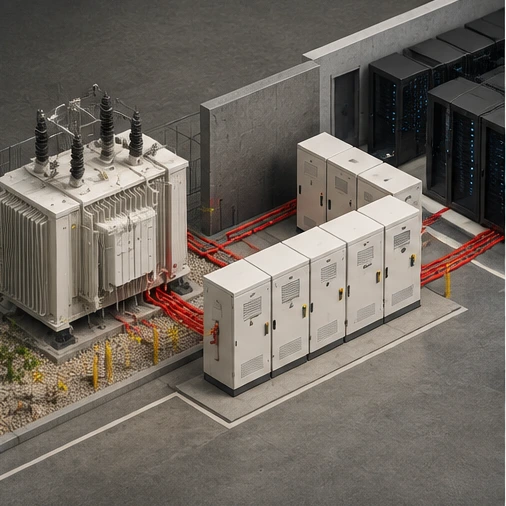
Public-source synthesis adapted from the Field Guide. Example editorial and spoken copy for Kevin’s review; not supplied personal opinions, firsthand experience, or published work.
A rack is the end of a chain.
A conceptual power path can include utility or approved onsite supply, medium-voltage intake and switchgear, transformers, low-voltage distribution, a UPS and stored energy, room distribution or busway, a rack PDU and the IT load. ASHRAE’s power-equipment guidance and public architecture resources provide vocabulary for these roles. The exact order, voltages, transfer arrangements and bypasses vary by design.
Do not treat that list as a one-line drawing or assume that every facility contains the same equipment. A transformer changes voltage. Distribution and protection equipment serve different functions. A room PDU and a rack PDU are not necessarily interchangeable descriptions. Ask what an acronym means in the source you are reading.
Capacity is not a single number.
A utility commitment does not, by itself, establish usable service capacity. Component ratings, ambient conditions, electrical and thermal limits, shared dependencies and maintenance arrangements affect the system. A UPS and a longer-duration alternate supply also have different roles. Naming both does not establish how a particular installation transfers or protects loads.
Two paths drawn on paper do not prove independence. They may share a source, controls, cooling or other upstream dependencies. Commissioning and integrated validation help qualified teams evaluate the intended system; a simplified learning diagram cannot replace that evidence. This draft neither specifies equipment nor prescribes switching or response actions.
Use the map to improve a handoff conversation.
For a new learner, draw a public-source map and label each stage’s purpose. For a leader, ask what dependency constrains the next increment of service and who can verify it. Separate what the source establishes from assumptions that need a qualified review. The useful outcome is a clearer conversation about evidence and ownership.
Keep real facility drawings, configuration details and control information out of public AI tools and portfolios. Use generic or synthetic material for practice. Approved procedures, employer-authorized training and qualified supervision—not generated text—govern work on real equipment.
Sources and further reading
Data Center Power Equipment Thermal Guidelines and Best Practices
Reviewed public source
Datacenter architecture and infrastructure
Reviewed public source
Commissioning and Performance Validation
Reviewed public source
Powering AI and Data Center Infrastructure Recommendations
Reviewed public source
Operations and Maintenance
Reviewed public source
The systems matter.
So does the conversation.
Grounded conversations about AI infrastructure, critical operations and leadership.