Power: follow the path, not just the label
A utility-to-rack map, the role of each link, and why resilience is about dependencies—not a single piece of equipment.
Unpublished editorial review · Source-led educational synthesis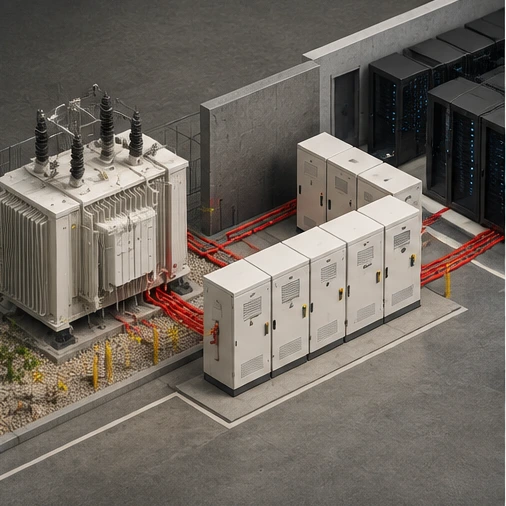
One illustrative path
Utility/grid and/or approved onsite sources → substation / medium-voltage (MV) intake → MV switchgear and protection → transformers → low-voltage (LV) switchgear → uninterruptible power supply (UPS), stored energy and bypass/transfer arrangement → power distribution unit (PDU), remote power panel (RPP) or busway → rack PDU → information technology (IT) load.
This is a conceptual map, not a one-line electrical drawing. The exact arrangement, voltage levels, bypasses, transfer points, onsite connection and redundancy vary. Protection coordinates how faults are isolated; transformers change voltage; switchgear distributes and protects circuits. A rack PDU distributes power to IT equipment, while a room PDU may include transformation and distribution. Do not assume the same acronym means the same equipment at every site.
Utility feeds, A/B paths and common dependencies
Two feeds or an A/B label do not by themselves prove independence. Feeds may share a substation, route, switchgear, controls or other upstream dependency. Dual-cord IT equipment may connect to separate paths, but cooling, controls and maintenance activities can still create shared risk.
N describes capacity needed for the load; N+1 adds a spare capacity component; 2N describes two complete capacity systems. These shorthand descriptions do not certify fault tolerance or maintainability. Ask what can be maintained, what failures were considered, and whether the entire dependency chain supports the intended availability.
Single-phase and three-phase are not power-path stages
Alternating current (AC) changes direction periodically. Single-phase describes one alternating waveform; three-phase uses three waveforms offset in time. Three-phase distribution can support large loads and feed single-phase circuits. This is a property of electrical supply, not three steps in the utility-to-rack chain.
Phase balancing is the qualified design and operating task of distributing loads appropriately across phases. Imbalance can affect currents and equipment loading; nameplate capacity alone does not reveal it. This guide contains no wiring, switching, testing or balancing instructions.
Capacity, quality and commissioning
Capacity depends on component ratings, operating conditions and the weakest shared link—not only the utility contract. Power quality includes voltage variation, frequency, harmonics and interruptions. An electrical power monitoring system helps people see these conditions; alarms require context and trained review.
Commissioning verifies design intent and interfaces, with evidence and unresolved issues carried into handoff. Integrated systems testing examines interactions under approved, engineered test plans. These are awareness concepts, never instructions to simulate a fault on live equipment.
Questions worth taking into a room
Where is the true upstream constraint? Which shared dependency could affect both paths? What capacity is reserved for maintenance? Who owns the commissioning evidence and exceptions? Ask qualified engineers for the approved architecture and employer training for authorized work.
- 01Utility / approved onsite source
- 02Substation / MV intake
- 03MV switchgear / protection
- 04Transformers
- 05LV switchgear
- 06UPS / stored energy / bypass & transfer
- 07PDU / RPP / busway
- 08Rack PDU
- 09IT load
Sources and further reading
Data Center Power Equipment Thermal Guidelines and Best Practices
Reviewed public source
Datacenter architecture and infrastructure
Reviewed public source
Power in Focus: Data centers
Reviewed public source
Commissioning and Performance Validation
Reviewed public source
Powering AI and Data Center Infrastructure Recommendations
Reviewed public source
The systems matter.
So does the conversation.
Grounded conversations about AI infrastructure, critical operations and leadership.