Field Guide / Build a path into the work

CAREER TRACKS.

System literacy. Practical evidence. A human way in.
Foundational learning for technicians and program leaders—not site qualification.

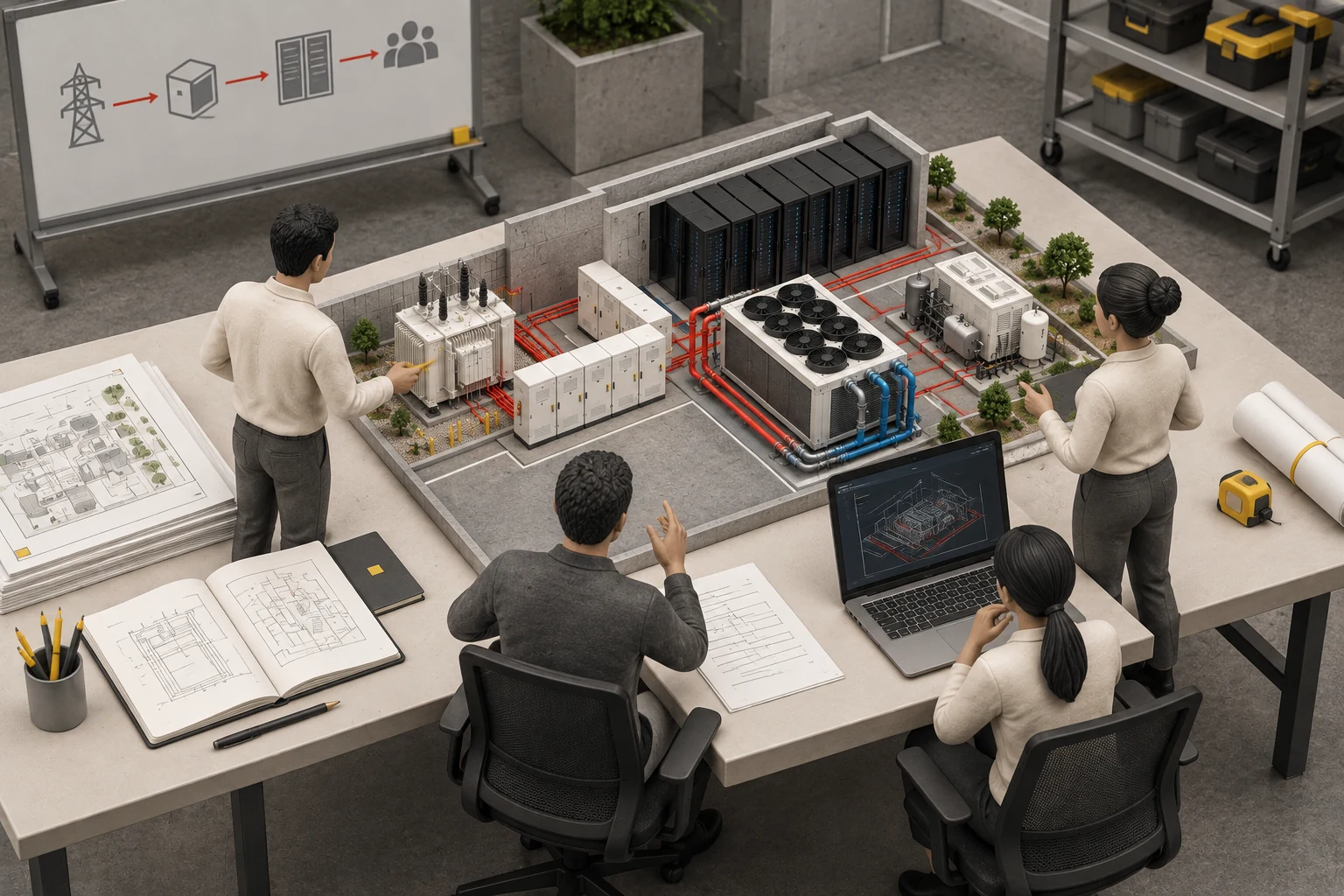
Illustrated people gathered around a workshop bench, not actual people or an event
Illustrative artwork · Not a real facility, event or technical diagram.
Publisher
iamsynchronized / Kevin Moore
Edition / publication
November 2026 starter edition
Resource type
Learning plan
Last reviewed
Nov 23, 2026

No four-year degree is required to use these plans. Hiring requirements and employer qualifications vary. All hands-on equipment work must be supervised and employer-authorized; paper exercises and public-source learning do not grant electrical, mechanical or life-safety authority. Official portals may have prerequisites, fees or enrollment requirements—check the publisher before committing.

12 weeks / Sequence, practice, evidence

CRITICAL-ENVIRONMENT TECHNICIAN

Career changers and new technicians. Begin with vocabulary and diagram literacy; no four-year degree is required to use this learning plan. Employer qualifications, supervision and local requirements are separate.

01

Safety and the system vocabulary

Learning objective
Distinguish awareness learning from authorized work; define electrical, mechanical and life-safety terms.
Practice
Build a glossary from public resources and identify where qualified engineers, the AHJ and employer training govern implementation.
Evidence of completion
A 20-term glossary and a written learning-versus-authorization boundary.
02

Single-phase, three-phase and one-lines

Learning objective
Read a generic one-line as a simplified system diagram; distinguish AC phases from distribution stages.
Practice
Annotate a public conceptual diagram with supply, transformer, protection and load labels. No measurements or equipment interaction.
Evidence of completion
An annotated diagram with five assumptions or unknowns explicitly listed.
03

Utility to rack

Learning objective
Explain the role of each link and identify common upstream dependencies.
Practice
Draw a generic utility-to-rack map with A/B paths and note where independence is unverified.
Evidence of completion
A system map and a short explanation of capacity versus maintainability.
04

UPS, generation and battery awareness

Learning objective
Distinguish ride-through, standby supply, ATS/STS, bypass and storage hazards.
Practice
Compare functions in a paper matrix; identify fuel, controls and stored-energy dependencies. No switching or battery handling.
Evidence of completion
A comparison matrix plus questions for an authorized trainer.
05

Heat transfer and chilled-water basics

Learning objective
Explain how air, coolant and refrigerant move heat; distinguish facility and condenser loops.
Practice
Trace heat across a public cooling diagram and mark heat exchangers.
Evidence of completion
A labeled heat path and an explanation of why recirculation need not mean zero water.
06

CRAC, CRAH and outdoor heat rejection

Learning objective
Compare DX, chillers, dry coolers, economizers and adiabatic assistance.
Practice
Compare two hypothetical climates without inventing energy or water savings.
Evidence of completion
A tradeoff sheet with climate, water, density and maintenance assumptions.
07

Liquid cooling interfaces

Learning objective
Describe cold plates, CDU, facility/technology loops, leaks and dew point.
Practice
Draw a conceptual liquid/air hybrid heat path and label manufacturer limits as unknowns.
Evidence of completion
A loop map and a list of leak, compatibility and condensation questions.
08

Monitoring and asset context

Learning objective
Separate BMS/BAS, EPMS, DCIM, CMMS, historians and life-safety functions.
Practice
Use invented non-sensitive readings to practice unit, timestamp and sensor-location checks.
Evidence of completion
A signal-to-asset map and an explanation of three misleading alarm scenarios.
09

Fire protection and emergency-plan awareness

Learning objective
Recognize detection, suppression and stored-energy hazards without prescribing response.
Practice
Summarize standard scopes and write questions for an employer’s approved emergency-plan orientation.
Evidence of completion
A scope summary and explicit statement that agents do not replace evacuation or trained responders.
10

Maintenance and change documentation

Learning objective
Understand preventive maintenance (PM), work orders (WO), approvals and handoff.
Practice
Draft a synthetic maintenance-record summary with facts, unknowns and approval fields—not an equipment work instruction.
Evidence of completion
A clearly fictional documentation sample and change-risk checklist.
11

Incident communication

Learning objective
Distinguish command, technical lead, safety and communications responsibilities.
Practice
Run a discussion-only tabletop with an invented alarm and no equipment actions; log observations and decisions.
Evidence of completion
A timestamped decision log and a concise fact/unknown/next-update summary.
12

Capstone: systems map and tabletop

Learning objective
Connect power, cooling, monitoring, safety and people without claiming operating qualification.
Practice
Present a generic systems map and facilitate a communication-only scenario; ask a qualified mentor to critique assumptions.
Evidence of completion
A portfolio map, source list, feedback notes and a plan for employer-authorized training.
10 weeks / Sequence, practice, evidence

PROGRAM-MANAGEMENT LEADER

Program managers, career changers and community leaders. Build system literacy and evidence-led communication; the track is foundational learning, not an engineering or operational credential.

01

System map and stakeholders

Learning objective
Explain dependencies among facility, IT, utility, vendors, safety and community.
Practice
Draw a public-source system map and stakeholder responsibility matrix.
Evidence of completion
A map that separates known facts, assumptions and unanswered questions.
02

Capacity and dependencies

Learning objective
Separate utility commitments, installed capacity, cooling limits and usable service capacity.
Practice
Review a fictional growth request and list electrical, thermal and control constraints.
Evidence of completion
A dependency register with owners and validation evidence needed.
03

Sustainability tradeoffs

Learning objective
Interpret PUE/WUE/ERE/CUE with periods, boundaries and local impacts.
Practice
Critique a company-reported metric using the claims-check questions.
Evidence of completion
A one-page brief distinguishing reporting from independent verification.
04

Commissioning and integrated validation

Learning objective
Understand design intent, interface validation, exceptions and handoff readiness.
Practice
Build a fictional evidence register; describe integrated systems testing without test instructions.
Evidence of completion
A readiness evidence matrix with unresolved items and decision owners.
05

Risk, change and vendor governance

Learning objective
Connect design changes and supplier interfaces to service and safety risk.
Practice
Write a synthetic change-review summary and vendor-interface responsibility matrix.
Evidence of completion
A risk register with accountable owners, assumptions and approval gates.
06

Incident command and executive updates

Learning objective
Keep technical ownership, safety, decisions and communications aligned.
Practice
Facilitate a discussion-only scenario; write a factual executive update without promising restoration.
Evidence of completion
An update with confirmed impact, unknowns, owners and the next agreed communication.
07

Monitoring and data storytelling

Learning objective
Explain baselines, sensor context, calibration and limits of correlation.
Practice
Chart invented data with units, timestamps and workload/weather assumptions.
Evidence of completion
A source-labeled chart and three hypotheses that require verification.
08

AI selection and validation

Learning objective
Choose bounded workflows with source truth, permissions and human approval.
Practice
Evaluate a public-source flashcard workflow or synthetic intake classifier on failure cases.
Evidence of completion
A validation sheet covering accuracy, privacy, access, cost and approval.
09

Career and community communication

Learning objective
Explain technical tradeoffs without overstating experience or credentials.
Practice
Prepare a public portfolio brief or short talk using only public material; invite peer feedback.
Evidence of completion
A sourced narrative with disclosure of learning versus firsthand experience.
10

Capstone: readiness narrative

Learning objective
Bring dependencies, risks, evidence and accountable decisions into one coherent brief.
Practice
Present a fictional readiness review; identify what evidence is missing and who must authorize implementation.
Evidence of completion
A readiness narrative, evidence register, feedback and next-learning plan.
Focused next steps / Awareness is not authorization

SPECIALIST MODULES.

Power: utility to rack

Prerequisites
Safety vocabulary, AC phase concepts and generic one-line literacy (technician weeks 1–3).
Objective
Compare supply, stored energy, transfer, protection and maintainability boundaries.
Practice
Annotate a public power map and dependency register.
Evidence
An annotated map with capacity assumptions and questions for an electrical trainer.
Next steps
Employer-authorized electrical awareness and qualified supervised training; no switching authorization is granted.

Mechanical: chillers and liquid cooling

Prerequisites
Heat-transfer and loop vocabulary (technician weeks 5–6).
Objective
Trace a hybrid heat path and compare climate, water and density tradeoffs.
Practice
Build a public-source loop map and condensation/compatibility question list.
Evidence
A map separating facility, technology and evaporative circuits.
Next steps
Manufacturer thermal training and supervised employer-approved practice; no refrigeration or coolant-handling qualification is granted.

Fire-protection awareness

Prerequisites
Safety vocabulary and an employer emergency-plan orientation before any site participation.
Objective
Understand standard scopes, detection, suppression and battery hazard boundaries.
Practice
Compare NFPA 75/2001/855 scopes and adopted-edition questions on paper.
Evidence
A scope matrix and a statement of evacuation/trained-responder boundaries.
Next steps
Approved employer training and AHJ/qualified fire-protection guidance; no life-safety operation or response qualification is granted.

Controls, monitoring and incident command

Prerequisites
System-map literacy and monitoring vocabulary (technician weeks 3 and 8).
Objective
Connect signals to assets, alarm ownership, escalation and factual communication.
Practice
Use synthetic data for a communication-only tabletop and trend review.
Evidence
A contextualized chart and decision/handoff log with unresolved questions.
Next steps
Approved controls training and employer-facilitated drills; no live auto-control integration is authorized.

OFFICIAL LEARNING, DIFFERENT PURPOSES.

Microsoft Learn provides an introductory vocabulary and operations overview. DOE FEMP offers energy resources, Data Center Profiler (DC Pro) tools and Data Center Energy Practitioner (DCEP) information. Uptime Institute AOS focuses on operations; ATS explores Tier concepts. Eaton and Vertiv offer vendor education. These are distinct programs with their own requirements—not equivalent credentials and not automatic employer authorization.

New to this? Start with the system →
Evidence / Follow the primary source

Sources and further reading

Vendor documentation

Introduction to datacenters

Publisher
Microsoft Learn
Edition / publication
Undated / living resource; no fixed edition verified
Resource type
technical guidance
Last reviewed
Nov 23, 2026

Reviewed public source

Vendor documentation

Power in Focus: Data centers

Publisher
Eaton
Edition / publication
Undated / living resource; no fixed edition verified
Resource type
technical guidance
Last reviewed
Nov 23, 2026

Reviewed public source

Standards guidance

NFPA 855: Installation of Stationary Energy Storage Systems

Publisher
NFPA
Edition / publication
2026 edition (publisher current)
Resource type
standard
Last reviewed
Nov 23, 2026

Publisher scope and edition reviewed; full standard requires NFPA access. Confirm locally adopted edition and amendments.

Vendor documentation

Continuing education sessions

Publisher
Vertiv
Edition / publication
Undated / living resource; no fixed edition verified
Resource type
technical guidance
Last reviewed
Nov 23, 2026

Reviewed public source

Standards guidance

Energy and Thermal Efficiency

Publisher
ASHRAE
Edition / publication
Undated / living resource; no fixed edition verified
Resource type
technical guidance
Last reviewed
Nov 23, 2026

Reviewed public source

Standards guidance

Operations and Maintenance

Publisher
ASHRAE
Edition / publication
Undated / living resource; no fixed edition verified
Resource type
technical guidance
Last reviewed
Nov 23, 2026

Reviewed public source

Standards guidance

Commissioning and Performance Validation

Publisher
ASHRAE
Edition / publication
Undated / living resource; no fixed edition verified
Resource type
technical guidance
Last reviewed
Nov 23, 2026

Reviewed public source

Standards guidance

NFPA 2001: Clean Agent Fire Extinguishing Systems

Publisher
NFPA
Edition / publication
2025 edition
Resource type
standard
Last reviewed
Nov 23, 2026

Publisher scope and edition reviewed; full standard requires NFPA access. Confirm locally adopted edition and amendments.

Vendor documentation

Learn about datacenter design

Publisher
Microsoft Learn
Edition / publication
Undated / living resource; no fixed edition verified
Resource type
technical guidance
Last reviewed
Nov 23, 2026

Reviewed public source

Company-reported claims

Measuring energy and water efficiency

Publisher
Microsoft Datacenters
Edition / publication
Undated / living resource; no fixed edition verified
Resource type
case study
Last reviewed
Nov 23, 2026

Reviewed public source

Vendor documentation

Accredited Operations Specialist

Publisher
Uptime Institute
Edition / publication
Undated / living resource; no fixed edition verified
Resource type
technical guidance
Last reviewed
Nov 23, 2026

Reviewed public source

Vendor documentation

What is Microsoft Copilot Studio?

Publisher
Microsoft Learn
Edition / publication
October 27, 2026
Resource type
product documentation
Last reviewed
Nov 23, 2026

Reviewed public source

Vendor documentation

Accredited Tier Specialist

Publisher
Uptime Institute
Edition / publication
Undated / living resource; no fixed edition verified
Resource type
technical guidance
Last reviewed
Nov 23, 2026

Reviewed public source

Kevin Moore / Bring it into the room

The systems matter.
So does the conversation.

Grounded conversations about AI infrastructure, critical operations and leadership.

Invite Kevin to speak