Before you clone, read the boundaries.
A public repository is a starting point for investigation—not a safety label, maintenance promise or production endorsement.
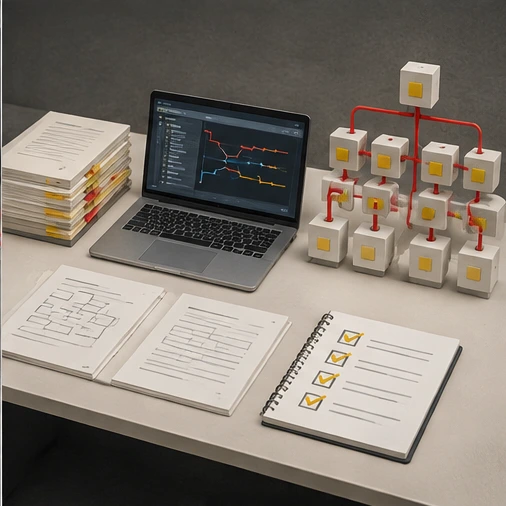
Public-source synthesis adapted from the Field Guide. Example editorial and spoken copy for Kevin’s review; not supplied personal opinions, firsthand experience, or published work.
Classify what you found.
An official sample, research artifact, simulator and operational software package are different things. A cookbook may teach an API pattern without providing deployment, access management or lifecycle support. A simulator can help study assumptions without predicting a real facility. An inventory application has a different adoption burden because it may hold sensitive configuration and access information.
The existing Field Guide source registry captures publisher, license metadata and dated repository status. Those are discovery signals, not a code audit. Read the README and current terms first. Identify the intended use, who maintains the project and whether the documentation describes a supported release or an experiment.
An update timestamp is not a quality verdict.
A recent push can be a documentation change, dependency update or automated activity. It is not necessarily a meaningful feature release. Read recent commits, releases, open issues and security guidance together. If a meaningful release or maintenance commitment cannot be verified, say that it is unverified rather than manufacturing a date or readiness score.
License detection can also be incomplete. A repository-level label may not cover every dataset, notebook or dependency. Check the actual license files and applicable terms before reuse. GitHub’s public advisory database can help identify known advisories, but an empty search or quiet security page does not establish that code is safe.
Explore without handing over your environment.
Begin by reading code in the browser. Follow entry points, dependency files, network calls, credential handling and requested permissions. GitHub’s code-navigation documentation explains supported navigation features; availability varies by language and indexing. Reading before executing is a useful first boundary, not a replacement for a security review.
If a qualified reviewer approves an experiment, use an isolated environment, synthetic data, least-privilege credentials and a budget limit. Keep secrets out of notebooks and version control. Never connect examples, simulations or model-generated commands to live facility controls. Organizational adoption needs an accountable owner, documented testing, support, rollback and approval—not just a successful demo.
Sources and further reading
openai/openai-cookbook
GitHub metadata reviewed; not a code or security audit
atlarge-research/OpenDC-STEAM
GitHub metadata reviewed; not a code or security audit
opendcim/openDCIM
GitHub metadata reviewed; not a code or security audit
Browsing security advisories in the GitHub Advisory Database
Public page checked; public advisory browsing is not a security audit or evidence of vulnerability-free software.
modelcontextprotocol/servers
GitHub metadata reviewed; not a code or security audit
TheDeadcoder/dc_ops_training
GitHub metadata reviewed; not a code or security audit
Navigating code on GitHub
Public page checked; code navigation depends on supported language and repository indexing.
The systems matter.
So does the conversation.
Grounded conversations about AI infrastructure, critical operations and leadership.