AI has a physical footprint.
Behind a useful answer is a chain of power, heat, infrastructure and human decisions. Follow the chain before judging the headline.
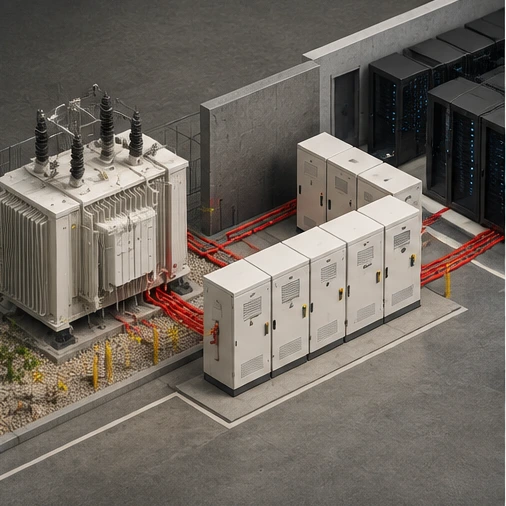
Public-source synthesis adapted from the Field Guide. Example editorial and spoken copy for Kevin’s review; not supplied personal opinions, firsthand experience, or published work.
The answer is digital. The support system is physical.
An AI service runs on computing equipment, not on an abstraction. That equipment needs electrical supply and produces heat that must be managed. DOE’s infrastructure recommendations frame electricity, efficiency and infrastructure as connected challenges. ASHRAE’s AI data center resources likewise place energy performance within a system of design and operating choices. Neither source gives one universal footprint for every AI answer.
A useful starting point is a map: where does energy enter, where does heat leave, and which people own the interfaces? That map is a learning tool, not a facility design. It makes a discussion about capability more concrete without pretending that a model benchmark tells us how the supporting infrastructure performs.
A number without a boundary can mislead.
A facility efficiency ratio, a renewable procurement claim and a useful-compute measure answer different questions. A power purchase agreement is a contract; it is not automatically a private wire delivering the same source in every hour. A facility-energy metric does not by itself establish lifecycle emissions, local water impact or the value of the computing performed. Keep the reporting period, included facilities and accounting method next to the claim.
Microsoft’s public efficiency disclosures are company-reported information. They can be useful context when their scope is retained, but they are not independent verification of a particular site or a reason to generalize a global ratio to every workload. This draft does not estimate per-prompt energy or water consumption.
Bring the conversation back to people.
For leaders and community audiences, the practical move is to separate a demonstrated capability from the conditions needed to sustain it. Ask about supply constraints, thermal limits, validation evidence and local impacts. Ask who can explain what is known and what still needs checking. A confident presentation is not the same thing as a complete dependency picture.
For an ATL-based community conversation, use public resources and plain language rather than an invented local facility story. Invite people to name what they would need to understand before accepting an infrastructure claim. That keeps the discussion grounded without attributing experiences or positions to Kevin that he has not supplied.
Sources and further reading
Powering AI and Data Center Infrastructure Recommendations
Reviewed public source
AI Data Center Energy Performance Framework
Reviewed public source
Grid-Interactive Design and Demand Flexibility
Reviewed public source
Best Practices Guide for Energy-Efficient Data Center Design
Reviewed public source
Measuring energy and water efficiency
Reviewed public source
Commissioning and Performance Validation
Reviewed public source
The systems matter.
So does the conversation.
Grounded conversations about AI infrastructure, critical operations and leadership.