Closed-loop does not mean zero-water.
A recirculating chip or building loop tells you where fluid moves—not how the whole facility rejects heat or accounts for water.
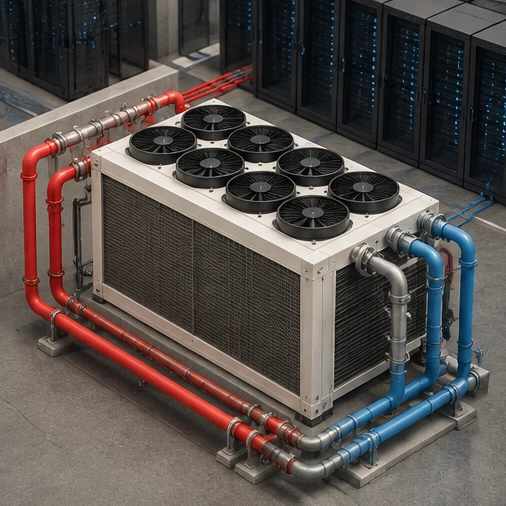
Public-source synthesis adapted from the Field Guide. Example editorial and spoken copy for Kevin’s review; not supplied personal opinions, firsthand experience, or published work.
First ask: which loop?
Cooling descriptions often use one familiar word for several different parts of a system. A technology loop may carry heat away from chips. A facility loop may move that heat through a building. A separate outdoor system may reject it to ambient air. A heat exchanger can keep two fluids separate while transferring energy between them. Saying one circuit is closed does not describe every circuit in the heat path.
DOE FEMP’s cooling-water guidance discusses water efficiency in systems that can include evaporative heat rejection. ITU’s cooling-selection guidance emphasizes scenario-dependent choices. Read them together: identify the heat-capture method, the transport loop and the outdoor rejection method before drawing a conclusion about water use.
Follow the heat to the boundary.
Recirculation and evaporation are not opposites at the whole-facility level. A recirculating circuit can transfer heat to another circuit that loses water through evaporation. Conversely, a dry heat-rejection design can reduce a particular cooling-water demand, but its performance depends on weather, temperatures, workload and design constraints. The phrase liquid-cooled does not settle those questions.
Water claims also need a stated accounting boundary. Cooling consumption, total site consumption, withdrawal and electricity-related upstream water are not the same measure. Avoid turning a component description into a zero-water claim for an entire facility. This draft makes no quantitative savings claim and does not certify any cooling architecture.
A better question is more useful than a correction.
Try asking: which loop is closed, where does the heat finally leave, and what water boundary is being reported? That gives a presenter room to clarify without assuming bad intent. Ask what changes during peak weather or maintenance, and which evidence supports the answer. These are literacy questions, not instructions to change a cooling system.
A simple paper heat map is enough for a first discussion. Label capture, transport, exchange and rejection. Mark unverified details as unknown. Keep licensed standards, manufacturer limits and site-specific operating decisions with the people qualified and authorized to interpret them.
Sources and further reading
Cooling Water Efficiency Opportunities for Federal Data Centers
Reviewed public source
L.1327: Cooling technology selection
Reviewed public source
Best Practices Guide for Energy-Efficient Data Center Design
Reviewed public source
Energy and Thermal Efficiency
Reviewed public source
The systems matter.
So does the conversation.
Grounded conversations about AI infrastructure, critical operations and leadership.