Fire protection: awareness, not a response procedure
Understand prevention, detection, suppression and battery hazards without mistaking an explainer for approved training.
Unpublished editorial review · Source-led educational synthesis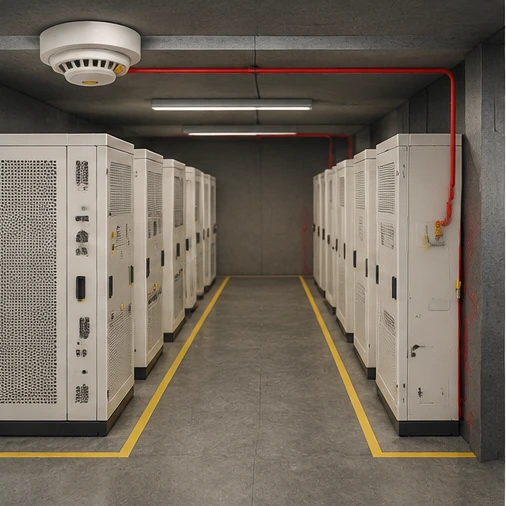
Prevention and detection
Fire prevention includes engineered equipment selection, maintenance, housekeeping, material and cable management, and authorized work controls. Very early smoke detection may use an aspirating system that samples air through pipes; spot detectors monitor specified locations. Suitability depends on airflow, layout, hazard and approved design.
Alarm and supervisory functions communicate different system conditions. A public learning guide cannot interpret a live panel or determine what a particular signal authorizes you to do. Follow the employer’s emergency plan and trained roles.
Suppression concepts
Pre-action sprinkler systems use a designed detection/valve arrangement before water delivery under specified conditions. Clean agents and inert-gas systems use engineered concentrations and enclosure conditions to suppress appropriate fire hazards. They are not interchangeable choices or a promise of no damage.
Selection depends on hazard analysis, occupancy, enclosure, equipment, adopted code and the authority having jurisdiction (AHJ). NFPA 75 (2024) addresses IT fire protection; NFPA 2001 (2025) addresses clean agent systems. Publisher scopes and editions were checked, not the full licensed standards. Confirm adopted editions, amendments and current interpretations with qualified professionals.
Stored energy changes the hazard picture
Battery hazards depend on chemistry, system design and failure mode. Thermal runaway and off-gassing can create heat, propagation and hazardous-atmosphere concerns that require specialized detection, ventilation, separation and response planning. NFPA 855 addresses stationary energy storage; its publisher currently lists the 2026 edition, but local adoption can differ.
An extinguishing agent does not replace evacuation, trained responders or approved emergency plans. This guide gives no release, isolation, reset, override, re-entry or firefighting instructions.
Company examples are not templates
Microsoft’s environmental-safeguards page describes its own architecture and controls. Treat it as a company-described example, not a design package, employer policy or operating procedure for any other facility. Implementation requires an AHJ, qualified engineers, manufacturers and employer-authorized training.
Sources and further reading
NFPA 75: Fire Protection of Information Technology Equipment
Publisher scope and edition reviewed; full standard requires NFPA access. Confirm locally adopted edition and amendments.
Datacenter environmental safeguards
Reviewed public source
NFPA 2001: Clean Agent Fire Extinguishing Systems
Publisher scope and edition reviewed; full standard requires NFPA access. Confirm locally adopted edition and amendments.
NFPA 855: Installation of Stationary Energy Storage Systems
Publisher scope and edition reviewed; full standard requires NFPA access. Confirm locally adopted edition and amendments.
The systems matter.
So does the conversation.
Grounded conversations about AI infrastructure, critical operations and leadership.