Economizers, evaporation and adiabatic heat rejection
Compare climate-dependent cooling opportunities without calling any of them universally “free.”
Unpublished editorial review · Source-led educational synthesis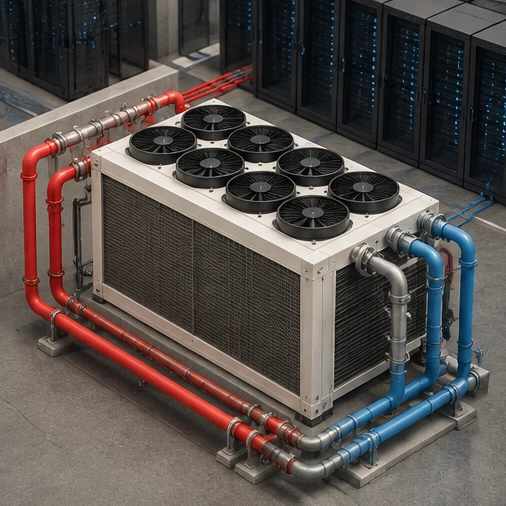
Economizers still use energy
Airside economizers use suitable outdoor air conditions to reduce mechanical cooling demand. Filtration, pollution, humidity, smoke, salt and controls affect suitability. Waterside economizers use favorable outdoor conditions through a heat exchanger and heat-rejection plant; they need not introduce outdoor air into the data hall.
“Free cooling” usually means reduced compressor demand, not zero fans, pumps or water. Available hours depend on outdoor dry-bulb and wet-bulb temperatures, equipment limits and required supply conditions. Annual weather and part-load modeling matter.
Direct versus indirect evaporative cooling
Direct evaporation cools the air stream through water evaporation and adds moisture to it. Indirect evaporation cools a separate stream or surface, transferring heat without necessarily adding that moisture to the IT air. Both need attention to water quality, treatment, controls and climate.
Dry climates can offer a useful wet-bulb temperature advantage; humid conditions can limit it. Performance and resource effects must be evaluated for the actual site and equipment. Indirect does not automatically mean water-free.
Adiabatic, dry and hybrid fluid coolers
Adiabatic assistance can pre-cool intake air by evaporation before it reaches a heat-rejection coil, often during selected conditions. A dry cooler transfers fluid heat to ambient air without intentionally evaporating water in that operating mode. A hybrid design combines dry and wet or assisted modes.
A dry mode may need more airflow, larger heat-exchange surface or higher fluid temperature in hot weather. Wet assistance may reduce some energy demand but introduces water consumption and maintenance needs. Compare annual operating modes and peak design conditions, not just a device label.
Climate and water tradeoffs
Compare local wet-bulb and dry-bulb conditions, water scarcity and quality, plume and noise limits, drought restrictions, workload density and required redundancy. Water-side benefits cannot be separated from treatment, blowdown, supply impacts and electricity generation. Ask which conditions require fallback mechanical cooling.
Sources and further reading
Best Practices Guide for Energy-Efficient Data Center Design
Reviewed public source
Data Center Power Equipment Thermal Guidelines and Best Practices
Reviewed public source
L.1327: Cooling technology selection
Reviewed public source
Cooling Water Efficiency Opportunities for Federal Data Centers
Reviewed public source
Energy and Thermal Efficiency
Reviewed public source
The systems matter.
So does the conversation.
Grounded conversations about AI infrastructure, critical operations and leadership.