CRAC, CRAH, DX and chilled water—plain English
What room cooling equipment does, why containment matters, and how heat gets out of the building.
Unpublished editorial review · Source-led educational synthesis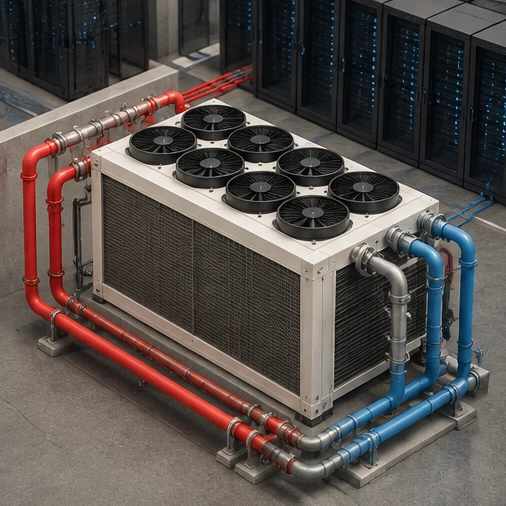
Room equipment versus the heat-rejection plant
A computer room air conditioner (CRAC) commonly uses direct expansion (DX) refrigeration. A refrigerant absorbs heat at an evaporator and rejects it through a condenser; a compressor and expansion device support the cycle. Product terminology varies, so inspect the manufacturer’s documentation rather than relying on an acronym.
A computer room air handler (CRAH) typically moves room air across a chilled-water coil. The coil transfers heat to a facility loop; the chiller and its heat-rejection system are elsewhere in the chain. A chilled-water room coil does not by itself tell you whether the chiller rejects heat to air or to a water circuit.
Air management is infrastructure
Hot/cold aisle layouts align rack air inlets and exhausts. Containment reduces mixing and recirculation; blanking and leak management help supply air reach intended inlets. Fans, pressure and airflow paths still need design and commissioning.
Hot-aisle containment isolates exhaust; cold-aisle containment isolates supply. Either approach has consequences for room conditions, access, fire systems and equipment compatibility. Containment is not a reason to change fire-protection arrangements or environmental setpoints without engineering approval.
Choosing among arrangements
DX can suit smaller or distributed spaces, but compressor energy, refrigerant management, capacity and serviceability matter. Central chilled water can aggregate loads and support economization, but brings pumps, distribution interfaces and plant dependencies. At part load, controls and component turn-down affect actual efficiency.
Site footprint, climate, workload density, redundancy, retrofit constraints and maintenance capability shape the design. A low published equipment rating does not establish a low annual facility footprint. Compare the full heat path and measured operating profile.
A safe learning exercise
Sketch a generic rack, room coil and outdoor heat-rejection system. Label where air, water and refrigerant may carry heat and where heat exchangers separate them. Explain the boundaries from public diagrams; do not inspect, open or manipulate live equipment.
Sources and further reading
Best Practices Guide for Energy-Efficient Data Center Design
Reviewed public source
L.1327: Cooling technology selection
Reviewed public source
NFPA 75: Fire Protection of Information Technology Equipment
Publisher scope and edition reviewed; full standard requires NFPA access. Confirm locally adopted edition and amendments.
Learn about datacenter design
Reviewed public source
The systems matter.
So does the conversation.
Grounded conversations about AI infrastructure, critical operations and leadership.